Informing the Food Transition
Robust and accurate food footprint data is needed to inform the sustainable food system transition.
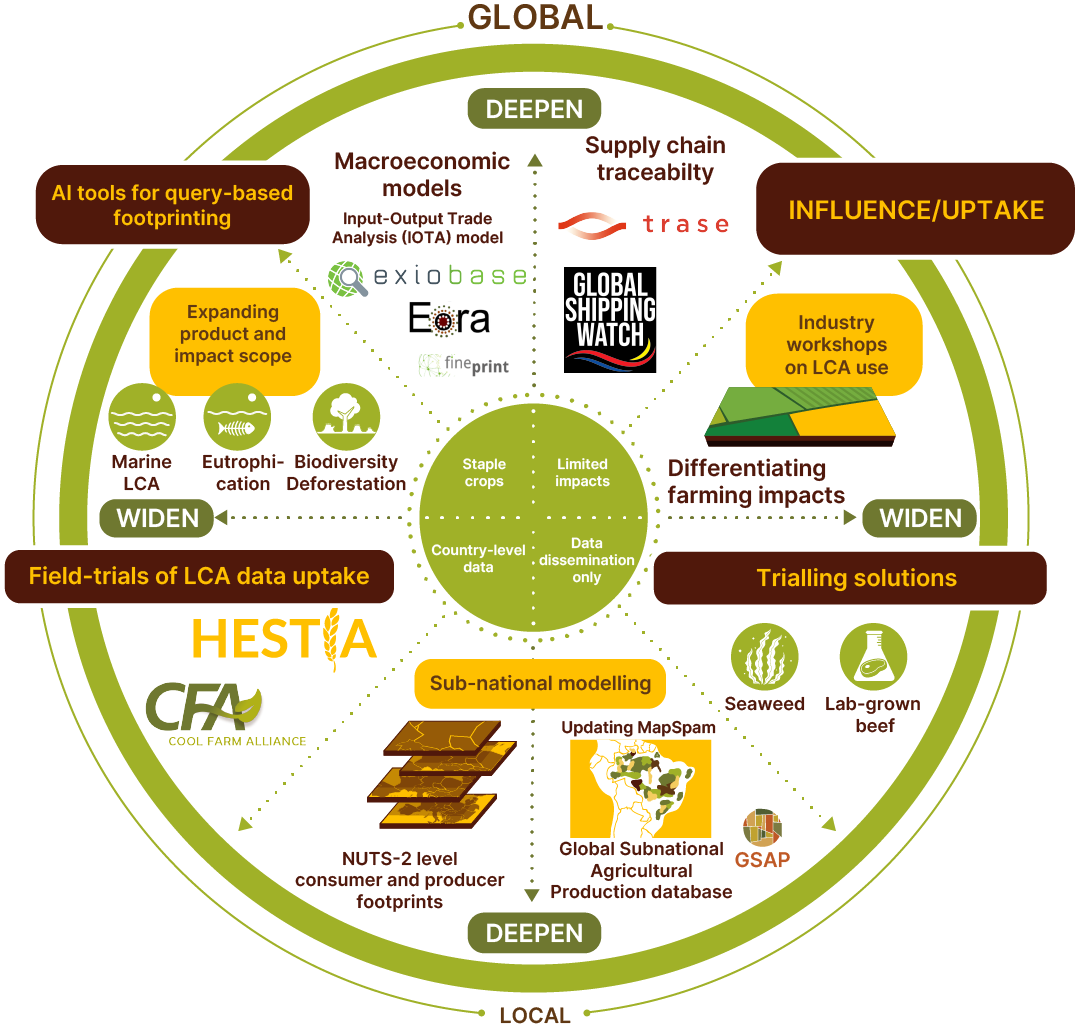
The GreenGrocer project invests in fundamental improvements in key food LCA platforms including Trase.earth, HESTIA, Eora, EXIOBASE, and the CoolFarm tool.
Currently, the knowledge infrastructure for food footpritn data falls short in terms of scientific robustness and its applicability to support regulatory and business decision-making processes. GREENGROCER aims to improve the food footprint data by strengthening knowledge infrastructure and consolidating tools such as Trase HESTIA, CoolFarm, and EXIOBASE, which collectively form the foundation of most food footprint data currently in use. The project will address gaps in supply chain specifics and the impacts of products, ensuring compliance with EU environmental standards. It will promote collaboration and align outputs with 13 EU policy frameworks.
AimsThe project has three aims:
- EU food system impacts on eutrophication, deforestation, and climate via global supply chain traceability.
- Quantifying underexplored impacts of aquatic food, such as overfishing, seafloor disturbance, and bycatch.
- Assessing the impact mitigation potential of food distribution, cold food chains, and novel foods.
- Advancing spatially explicit agricultural production data.
- Compliance of major food footprint databases with the EU's Product Environmental Footprint standards
- FAIR-ness of current mainstream and emerging tools to broker access to industry and consumers
- Data standardisation and interoperability to facilitate multi-model food footprinting.
- Deploying HESTIA's farm sustainability toolkit, co-created with farmers, to ~20,000 farms in Europe.
- Updating the CoolFarm Tool, reaching c.10,000 users speaking 17 langauges across leading food-beverage firms.
- Consumer surveys to identify opportunities for novel foods and diet shifts.
- Developing sector-specific regulatory standards for EFRAG disclosure in the food and beverages sector.
- Develop and promote data sharing and transparency.
Objectives
The GreenGrocer team has six specific objectives which support the project aims:
SO-1 Filling in the incomplete foundations of food footprint data by filling key blindspots
- Fill food footprint blind spots of eutrophication, deforestation, marine foods, and antibiotic use.
- Increase temporal, regional, subnational and product coverage and specificity of food impact databases.
- Standardise production stressor accounts for multi-model application: Material Flow Analyses (MFAs)/ Life Cycle Assessments (LCAs)/Multi-regional Input-output models (MRIOs) and derive a Product Environmental Footprint (PEF) compliant database.
- Advance footprinting tools for use in industry and regulation monitoring and goal-setting.
SO-2 Locate and measure socio-economic trade-offs and synergies of a sustainable EU food transition
- Evaluate economic trade-offs of sustainable farming in farm-level field trials and tools (~1,000 EU farms).
- Conduct deep dives to study and scale innovative food solutions (e.g.cellular agriculture, seaweed).
- Assess nutrition of consumer sub-groups in 242 NUTS-2 regions, currently and for future food scenarios.
- Conduct workshops and farm trials to assess industry readiness for food production innovations
SO-3 Perform foundation-strengthening improvements in existing mainstream public data tools.
- Collate and assess technological readiness, FAIRness and PEF compliance key food-impact datasets.
- Set recommendations for (and implemented selected) improvements via data-provider engagement.
- Increase dissemination and uptake of food impact knowledge via a specialist AI agent.
SO-4 Identify and evaluate innovations that deliver sustainable EU food production, consumption and trade
- Map food innovations: seaweed, insects, cellular agriculture, cold chains, and restaurant waste reduction.
- Identify barriers to uptake of food innovations within the EU via industry workshops and case studies.
- Assess the scalability and impacts of innovations in EU-wide food system transition scenarios.
SO-5 Advance knowledge of the environmental impacts of innovative food supply and transport solutions
- Increase traceability of food-linked supply chain impacts to better target interventions/solutions.
- Evaluate trade methods and routes of all food traded from and to the EU and environmental sustainability.
- Demonstrate innovative solutions to freeze products to allow for low-carbon cold chains by land and sea.
SO-6 Accelerate uptake of new scientific knowledge and tools by key food system actors
- Increase dissemination and uptake of data via an specialist AI agent (also meeting SO-3).
- Deploy new food impact data to ~20,000 EU farms to guide sustainability appraisal of farm techniques.
- Improve the scientific basis of the CoolFarm Tool — a platform used by 10,000+ farmers / 150+ companies
- Identify key barriers to use of existing food footprinting tools across the EU's food and beverage sector
Approaches
Context
GreenGrocer is a Research and Innovation project funded under the Horizon Europe programme of the European Commission. The project was funded under the call for research on environmental impacts of food systems in Cluster 6: "Food, Bioeconomy, Natural Resources, Agriculture and Environment".
The GreenGrocer team consists of 22 partners in 11 European countries. The project start date was September 2025 and the end date is August 2029.